

- AUDIO ONE-TO-ONE Call Now: 210-805-9927
- Contact
- Register
- My Account
Imersiv D-1 HDR-A Multi-Path DAC
Imersiv D-1 HDR-A Multi-Path DAC
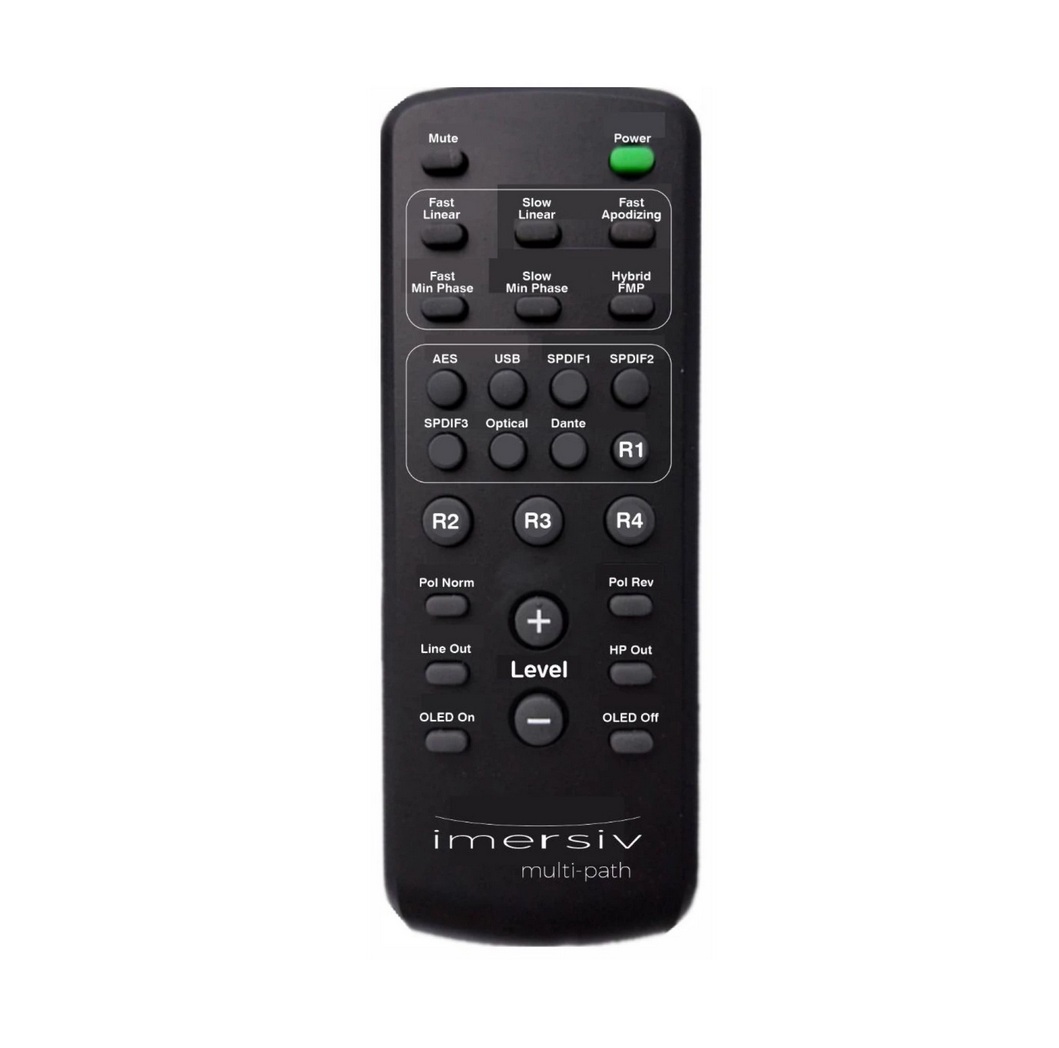
Imersiv D-1 HDR-A Multi-Path DAC
Imersiv D-1 HDR-A Multi-Path DAC
Description

MY TAKE: The imersiv D-1 is represents a most significant advance in digital-to-analog conversion. The measurements are extraordinary. More importantly, what you hear confirms them. This is not incremental progress — it is a genuine paradigm shift, and I am thrilled to offer it.- Galen Carol
Some products come along that demand you sit up and pay attention — not because of clever marketing or flashy aesthetics, but because they represent a fundamental rethinking of how something works. The imersiv D-1 is that product for digital audio.
Imersiv is the consumer-facing brand of Millennia Media, a company with 35 years of pro audio heritage built on an almost fanatical commitment to accuracy and neutrality. Millennia’s preamplifiers are the leading choice for Hollywood film scores, classical music recordings, and major broadcast events including the Grammys and Oscars. Their LOCi phono preamplifier was designed under contract for the U.S. Library of Congress. With over 50,000 recording channels in use worldwide, if you listened to music or watched a film today, chances are good you heard a Millennia recording. This is not a boutique startup making bold claims — this is a company whose work has shaped the sonic fabric of modern culture, now turning its full attention to the DAC.
The Technology -At the heart of the D-1 is what Millennia calls HDR-A — High Dynamic Range Audio — a triple-patented, multi-path architecture that took founder John La Grou over a decade to bring to fruition. The concept is elegantly analogous to HDR photography, in which multiple stacked exposures are intelligently combined into a single image. Here, multiple stacked audio levels are summed into a single audio file — one low-level path covering 0–90dB of dynamic range, and one high-level path covering 80–180dB — with a sophisticated DSP crossfade invisibly managing the transition between them.
The result is a DAC that operates at extraordinarily low distortion across its entire dynamic range, not just at the top. At low signal levels — where standard DACs exhibit their worst waveform distortion — the D-1’s multi-path HDR-A architecture routes signals through a fresh DAC core optimized specifically for that range. Single-path waveforms at these levels are jaggy and noisy; we hear this as poor image definition, atmospheric collapse, and a blurring of complex timbres. The D-1’s low-level signals remain pure and natural, even far below the threshold of human hearing.
The specifications are unlike anything else on the market. The D-1 achieves a broadband noise floor of just 40 nanovolts — approximately 40dB lower, or 100 times quieter, than today’s finest competing DAC designs. The D-1’s self-noise actually sits 25dB below what the leading test equipment, such as the APx555B, is even capable of measuring. True dynamic range comes in at 28 bits, or 168dB — a figure that renders today’s best single-path converters unable to compete, on paper or in practice.
What the Reviewers Are Saying -
The critical response has been unambiguous. Michael Lavorgna, who spent six years as Editor of AudioStream and has continued his digital quest at Twittering Machines for another seven, maintains a very short list of digital components that have genuinely made him say “Wow.” "If you want to hear the best sounding stand alone DAC I’ve heard, you need to listen to the Imersiv D-1. No ifs, ands, or buts." That list includes the totaldacs, the dCS Network Bridge, and the Grimm MU1 and MU2 — and he has now added the imersiv D-1.
Full Review from Twittering Machines Here
"The imersiv D‑1 is genuinely in a class of its own: there is absolutely nothing on the market at the time of writing that comes anywhere close to matching its dynamic range and low‑distortion capability."
"The imersiv D‑1 is the first product to employ a revolutionary approach to D‑A converter design, and it shows. The D‑1 achieves a dynamic range that’s two orders of magnitude (40dB) greater than even the very best of its contemporaries, and a noise floor so low that it’s unmeasurable. This really is the new state of the art!" - Hugh Robjohns - Sound On Sound
Pros
A genuine step‑change in DAC technology.
Groundbreaking technical specs.
Lower distortion clearly audible.
Easy to configure.Cons
I can’t afford one!
Full Review from Sound On Sound
"There's nothing inconclusive here. In the year 2025 we are about to experience a major improvement in digital reproduction. The D1 outmodes all other current DACs! This includes all music players, streamers, any device that incorporates a DAC. Its three dimensionality is intuitively obvious to the most casual observer! Measurement-wise, its signal to noise ratio, dynamic range and distortion exceed the performance of all other DACs by orders of magnitude! As far as this reviewer is concerned, the company's claims of a once-in-a-generation paradigm shift are supported by the evidence. I predict that other manufacturers will soon be scrambling to license the patented technology from Millennia Media." - Bob Katz, Positive Feedback
Full Review from POsitive Feedback Here
Sound and Use - "So, is the Imersiv D-1 DAC the paradigm-shifting, sonic game-changer that it claims to be? To my ears, in both my home listening room, as well as in my professional mix room, “abso-freaking-lutely.” I compared the D-1 DAC to six other well-respected (and great-sounding) top-line converters, and music played back through the D-1 DAC exhibited notable sonic differences across the board. There was greater detail to be found in string plucks and strums, bowing on strings, finger taps, stick hits on cymbals and drum heads, and vocal nuances. There was also an improvement in the depth and spatial cues in the music. It was like I could aurally “see” deeper into the soundstage. While we often associate clarity with high frequencies, this added detail also extends to the low end, which, across the board, sounded more defined as well. The biggest shock to me was that 16-bit CD audio sounds better through the D-1 DAC, let alone hi-res and DSD files (which the D-1 can accommodate). In addition to USB, the inclusion of Dante allowed me to easily integrate the unit into my mixing room, which let me take advantage of the increased detail when mixing my last two projects. The extended low-level detail found in the D-1 DAC was especially apparent in the clarity of reverb tails and room mics." - Paul Vnuk, Jr. - Recordingmag.comFrom the pro audio community, the endorsements are equally direct:
“This is the first time with digital audio where I’ve been surprised at an actual, tangible leap forward.” — Tape Op Magazine
“This converter is like no other I have heard.” — Jack Joseph Puig, Grammy-winning Engineer
“It’s amazing how the D-1 pulls the listener deeper into the music. This will be the industry standard.” — Dan Shea, Producer“Fundamentally changes professional audio.” — Ryan Robinson
The Bottom Line -
At $12,000, the D-1 competes directly with the finest converters from dCS, Mola Mola, and others — and by every measure we have, it surpasses them. For those who have been waiting for digital to truly deliver on its promise of analog-like naturalness and ease, the wait is over.
Build and Practicalities -
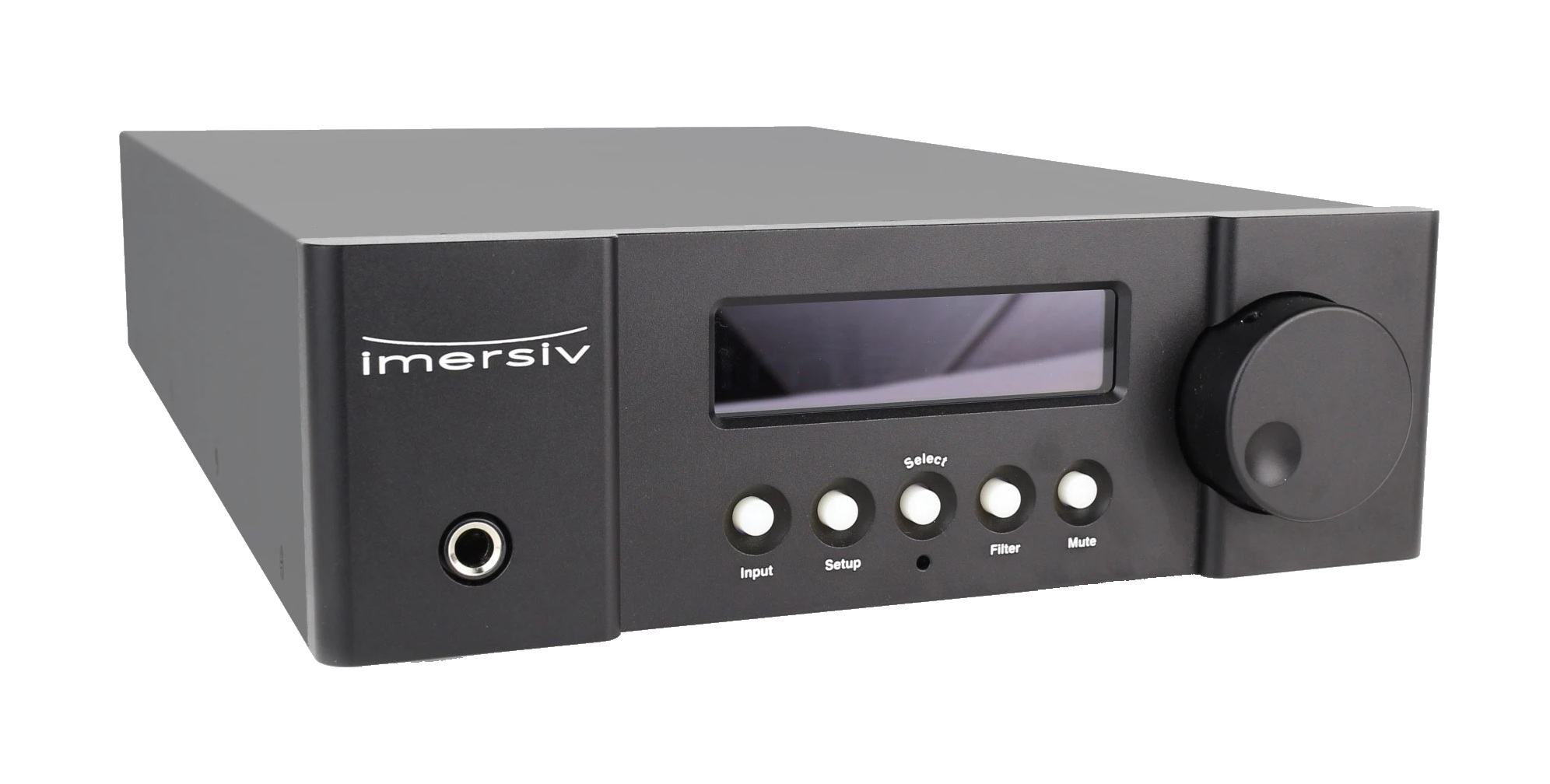
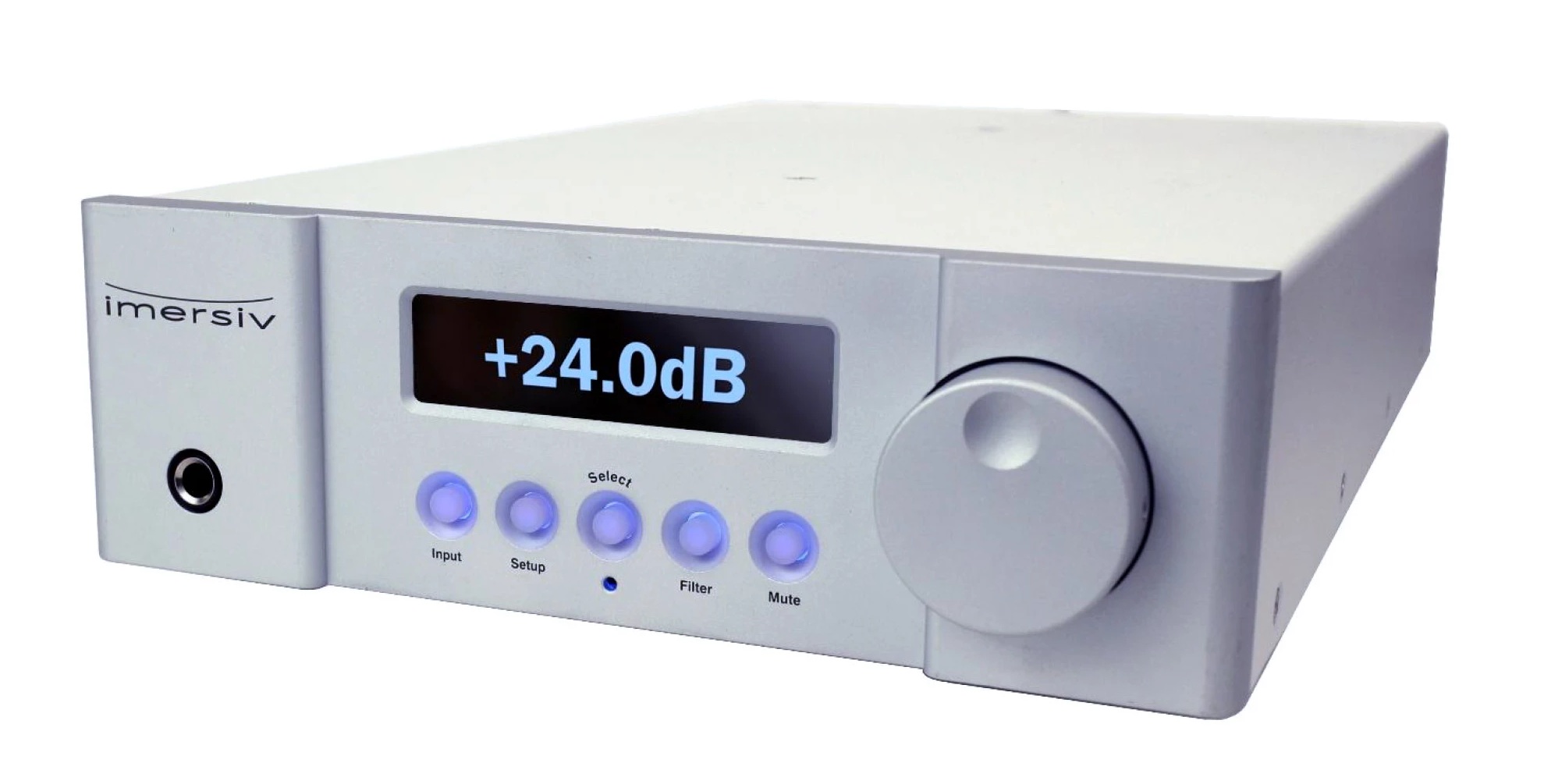
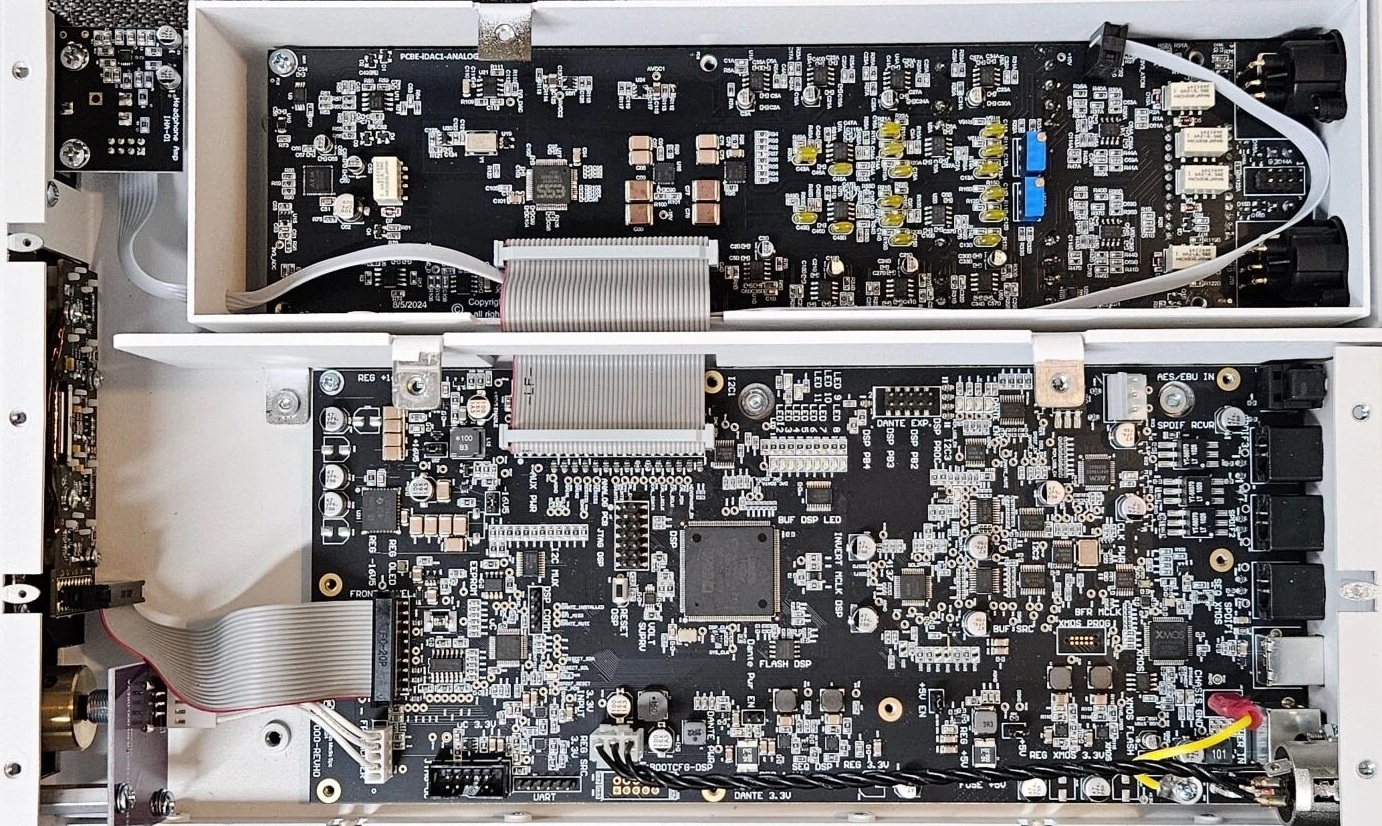
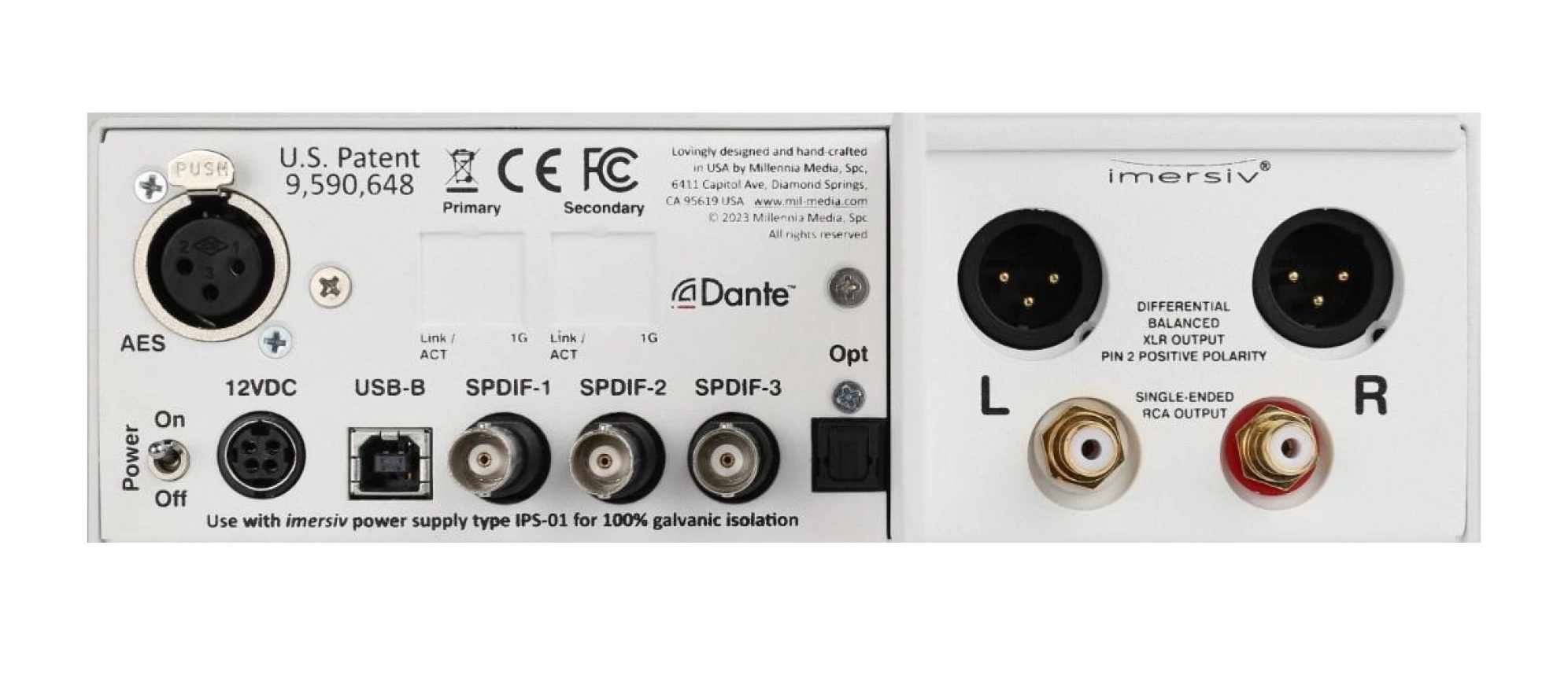
The D-1 is housed in a compact half-rack, 2U chassis with a clean, purposeful industrial aesthetic that reflects its professional lineage. A 10-gauge aluminum plate running the full internal length of the chassis provides RF shielding between the digital and analog PCBs — a physical reminder of just how quiet the analog output section truly is, and a signal to the user to employ the shortest, best-shielded XLR cables available. Multiple digital inputs are provided, with optional expansion cards for Dante and a balanced headphone amplifier available separately.
Specifications -Architecture: Multi-path HDR-A (High Dynamic Range Audio), triple-patented
Dynamic Range: 168dB (28-bit linearity)
Output Noise Floor: 40 nanovolts broadband (−146dBu)
Headroom: +22dBu (10 volts), ISO-free
Format: Half-rack, 2U chassis
Outputs: Balanced XLR (recommended); RCA utility outputs
Optional Expansions: Dante input card; balanced headphone amplifier
Price: $12,000

Imersiv D-1 HDR-A Multi-Path DAC
Description
MY TAKE: The imersiv D-1 is represents a most significant advance in digital-to-analog conversion. The measurements are extraordinary. More importantly, what you hear confirms them. This is not incremental progress — it is a genuine paradigm shift, and I am thrilled to offer it.- Galen Carol
Some products come along that demand you sit up and pay attention — not because of clever marketing or flashy aesthetics, but because they represent a fundamental rethinking of how something works. The imersiv D-1 is that product for digital audio.
Imersiv is the consumer-facing brand of Millennia Media, a company with 35 years of pro audio heritage built on an almost fanatical commitment to accuracy and neutrality. Millennia’s preamplifiers are the leading choice for Hollywood film scores, classical music recordings, and major broadcast events including the Grammys and Oscars. Their LOCi phono preamplifier was designed under contract for the U.S. Library of Congress. With over 50,000 recording channels in use worldwide, if you listened to music or watched a film today, chances are good you heard a Millennia recording. This is not a boutique startup making bold claims — this is a company whose work has shaped the sonic fabric of modern culture, now turning its full attention to the DAC.
The Technology -
At the heart of the D-1 is what Millennia calls HDR-A — High Dynamic Range Audio — a triple-patented, multi-path architecture that took founder John La Grou over a decade to bring to fruition. The concept is elegantly analogous to HDR photography, in which multiple stacked exposures are intelligently combined into a single image. Here, multiple stacked audio levels are summed into a single audio file — one low-level path covering 0–90dB of dynamic range, and one high-level path covering 80–180dB — with a sophisticated DSP crossfade invisibly managing the transition between them.
The result is a DAC that operates at extraordinarily low distortion across its entire dynamic range, not just at the top. At low signal levels — where standard DACs exhibit their worst waveform distortion — the D-1’s multi-path HDR-A architecture routes signals through a fresh DAC core optimized specifically for that range. Single-path waveforms at these levels are jaggy and noisy; we hear this as poor image definition, atmospheric collapse, and a blurring of complex timbres. The D-1’s low-level signals remain pure and natural, even far below the threshold of human hearing.
The specifications are unlike anything else on the market. The D-1 achieves a broadband noise floor of just 40 nanovolts — approximately 40dB lower, or 100 times quieter, than today’s finest competing DAC designs. The D-1’s self-noise actually sits 25dB below what the leading test equipment, such as the APx555B, is even capable of measuring. True dynamic range comes in at 28 bits, or 168dB — a figure that renders today’s best single-path converters unable to compete, on paper or in practice.
What the Reviewers Are Saying -
The critical response has been unambiguous. Michael Lavorgna, who spent six years as Editor of AudioStream and has continued his digital quest at Twittering Machines for another seven, maintains a very short list of digital components that have genuinely made him say “Wow.” "If you want to hear the best sounding stand alone DAC I’ve heard, you need to listen to the Imersiv D-1. No ifs, ands, or buts." That list includes the totaldacs, the dCS Network Bridge, and the Grimm MU1 and MU2 — and he has now added the imersiv D-1.
Full Review from Twittering Machines Here
"The imersiv D‑1 is genuinely in a class of its own: there is absolutely nothing on the market at the time of writing that comes anywhere close to matching its dynamic range and low‑distortion capability."
"The imersiv D‑1 is the first product to employ a revolutionary approach to D‑A converter design, and it shows. The D‑1 achieves a dynamic range that’s two orders of magnitude (40dB) greater than even the very best of its contemporaries, and a noise floor so low that it’s unmeasurable. This really is the new state of the art!" - Hugh Robjohns - Sound On Sound
Pros
A genuine step‑change in DAC technology.
Groundbreaking technical specs.
Lower distortion clearly audible.
Easy to configure.
Cons
I can’t afford one!
Full Review from Sound On Sound
"There's nothing inconclusive here. In the year 2025 we are about to experience a major improvement in digital reproduction. The D1 outmodes all other current DACs! This includes all music players, streamers, any device that incorporates a DAC. Its three dimensionality is intuitively obvious to the most casual observer! Measurement-wise, its signal to noise ratio, dynamic range and distortion exceed the performance of all other DACs by orders of magnitude! As far as this reviewer is concerned, the company's claims of a once-in-a-generation paradigm shift are supported by the evidence. I predict that other manufacturers will soon be scrambling to license the patented technology from Millennia Media." - Bob Katz, Positive Feedback
Full Review from POsitive Feedback Here
Sound and Use - "So, is the Imersiv D-1 DAC the paradigm-shifting, sonic game-changer that it claims to be? To my ears, in both my home listening room, as well as in my professional mix room, “abso-freaking-lutely.” I compared the D-1 DAC to six other well-respected (and great-sounding) top-line converters, and music played back through the D-1 DAC exhibited notable sonic differences across the board. There was greater detail to be found in string plucks and strums, bowing on strings, finger taps, stick hits on cymbals and drum heads, and vocal nuances. There was also an improvement in the depth and spatial cues in the music. It was like I could aurally “see” deeper into the soundstage. While we often associate clarity with high frequencies, this added detail also extends to the low end, which, across the board, sounded more defined as well. The biggest shock to me was that 16-bit CD audio sounds better through the D-1 DAC, let alone hi-res and DSD files (which the D-1 can accommodate). In addition to USB, the inclusion of Dante allowed me to easily integrate the unit into my mixing room, which let me take advantage of the increased detail when mixing my last two projects. The extended low-level detail found in the D-1 DAC was especially apparent in the clarity of reverb tails and room mics." - Paul Vnuk, Jr. - Recordingmag.com
From the pro audio community, the endorsements are equally direct:
“This is the first time with digital audio where I’ve been surprised at an actual, tangible leap forward.” — Tape Op Magazine
“This converter is like no other I have heard.” — Jack Joseph Puig, Grammy-winning Engineer
“It’s amazing how the D-1 pulls the listener deeper into the music. This will be the industry standard.” — Dan Shea, Producer
“Fundamentally changes professional audio.” — Ryan Robinson
The Bottom Line -
At $12,000, the D-1 competes directly with the finest converters from dCS, Mola Mola, and others — and by every measure we have, it surpasses them. For those who have been waiting for digital to truly deliver on its promise of analog-like naturalness and ease, the wait is over.
Build and Practicalities -
The D-1 is housed in a compact half-rack, 2U chassis with a clean, purposeful industrial aesthetic that reflects its professional lineage. A 10-gauge aluminum plate running the full internal length of the chassis provides RF shielding between the digital and analog PCBs — a physical reminder of just how quiet the analog output section truly is, and a signal to the user to employ the shortest, best-shielded XLR cables available. Multiple digital inputs are provided, with optional expansion cards for Dante and a balanced headphone amplifier available separately.
Specifications -
Architecture: Multi-path HDR-A (High Dynamic Range Audio), triple-patented
Dynamic Range: 168dB (28-bit linearity)
Output Noise Floor: 40 nanovolts broadband (−146dBu)
Headroom: +22dBu (10 volts), ISO-free
Format: Half-rack, 2U chassis
Outputs: Balanced XLR (recommended); RCA utility outputs
Optional Expansions: Dante input card; balanced headphone amplifier
Price: $12,000
