

- AUDIO ONE-TO-ONE Call Now: 210-805-9927
- Contact
- Register
- My Account
VACUUM RECORD CLEANING MACHINES
For some years now, the most effective methods of deep cleaning LPs have employed vacuum. This process utilizes a cleaning solution and hand held brush to loosen the dirt and debris trapped in the bottom of the grooves. The final step introduces a vacuum removal system to lift the dirty solution from the grooves, leaving clean vinyl behind.
Although effective, early vacuum record cleaning machines were quite expensive. In the late '70s the Keith Monks machine from Britain was introduced, making it the first of the vacuum machines to appear. However, selling at over $2500.00, it was beyond the reach of most audiophiles. In 1980 Harry Weisfeld at VPI developed a low cost alternative to the Monks machine. His design employed a far simpler, yet equally effective, approach to the problem. This machine has been refined over the years into what is known today as the HW 16.5. Thousands have been sold world-wide, to a broad range of satisfied users. Individual collectors, audiophiles, music libraries, record stores and radio stations have all realized the practical benefits of owning such a machine.
The effectiveness of the vacuum record cleaning process is startling. These machines can literally transform a dirty record into a sparkling vinyl disc that sounds better than new. Of course no machine can repair damage to the vinyl, but the dust, dirt and other contaminants that obscure subtle detail are totally 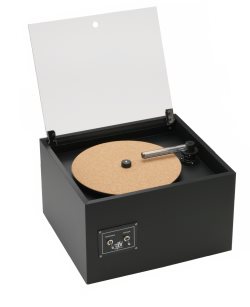 removed, with astonishing results. Even new, un-played records are contaminated with mold release compound which obscures detail. Removal of this material will improve performance.
It is likely that many of your favorite records are irreplaceable, some may be worth a good deal of money. It makes sense to protect your investment. Did you know that playing a dirty record can cause irreparable damage to the vinyl? Dust, dirt and debris, that have accumulated over time in the grooves of your LPs, presents a potential hazard if contacted by the stylus during play. Such a collision between stylus and dust creates what is known as a conchoidal shock wave. This event can actually pit the groove wall causing a permanent, irreparable damage, resulting in a "click" or "pop," to be heard on every successive pass. The only way to avoid this damage is to make certain that the grooves of your records are scrupulously clean. The best way to deep-clean your records is with a vacuum record cleaning machine, then use a good dry brush before each play as maintenance.
We feel the VPI units offer superior value to all other units we have tested. The construction quality, reliability, ease of maintenance and efficiency of design, are features that make the VPI an obvious choice. Interestingly, the Library of Congress has chosen VPI to maintain their collection of 126,000+ discs.
A number of brands and models have been introduced over the years offering a range of features and technology. Lately, new designs employing ultrasonic deep cleaning of the record grooves have appeared. While they are effective, these machines require special cleaning solutions and are significantly more expensive than their competition employing standard vacuum cleaning.
In selecting a machine, budget will likely be a primary concern. Beyond the initial cost, consider the number of LPs you have and the percentage of your listening you devote to analog. The larger (and more valuable) your collection, the more important proper cleaning and maintenance become.