

- AUDIO ONE-TO-ONE Call Now: 210-805-9927
- Contact
- Register
- My Account
RECORD CLEANING AND MAINTENANCE
Cleanliness is absolutely mandatory if the optimum sonic capability of the vinyl medium is to be realized. A clean record will not only sound better but last longer. It has been shown that repeated playing of soiled records can cause permanent damage to the vinyl. Preservation of valuable or irreplaceable records requires careful cleaning. Further, stylus wear is greatly accelerated by dust and debris in the grooves. With cartridges costing what they do these days, playing soiled records inevitably leads to significant and unnecessary expense.
As the stylus navigates its torturous travails through the undulating grooves, incredible pressures are exerted on the vinyl which, in turn, produces considerable heat. This process alone is hard enough on the relatively soft vinyl that comprises the LP, add to this equation the dust, dirt and other contaminants so often found on our records, and we have a recipe for disaster.
It has been shown that contact between the stylus and certain debris produces a mini-explosion of sorts, known as a conchoidal shock-wave. This incident literally "blasts" a hole into the groove wall. The resulting pit reveals itself during each and every successive play as a tick or pop, and nothing short of buying a new record will eliminate it. The only way to prevent this catastrophic damage is to make certain that the grooves are scrupulously clean before stylus ever touches vinyl.
Now that we understand the importance of a pristine record, let's look at how to effectively clean our own collection. To begin, it will be useful to classify the methods available into categories - dry and wet cleaning. Dry methods employ some type of brush that is designed to sweep the record surface, thus removing dust. Wet methods use a fluid of some sort to enhance the process. Dry brushes are best used as part of a maintenance program to keep records clean, wet methods are used on an occasional basis to deep-clean the grooves. As I see it, both methods are important, and mandatory if you want to preserve a valuable collection or want the very best performance.
Let us first look at dry brush technology. Years ago, the WATTS Company in Britain began producing the first effective range of dry brush designs with products such as the Disc-Preener and Dust-Bug. Both devices employed a simple plush pad to remove dust from the surface of the record. Then came the ubiquitous Discwasher, a directional nap dry brush supplied with their own cleaning fluid. It's amazing to many how many of these systems were sold and even more surprising that many are still in use today (unfortunately!).
The next step in dry brush technology was taken by another British firm, DECCA, which introduced the first brush to use tiny carbon fibers. Some one million individual fibers are in each brush, the purpose of which were to deep-clean the grooves while removing static. It worked, but it also shed fibers.
Furthering the concept pioneered by DECCA, was the Hunt/EDA record brush which employed a leading and trailing row of carbon fiber bristles with a velvet-like plush pad in between. We liked the Hunt/EDA a great deal, but found that the carbon fibers were stiff and created 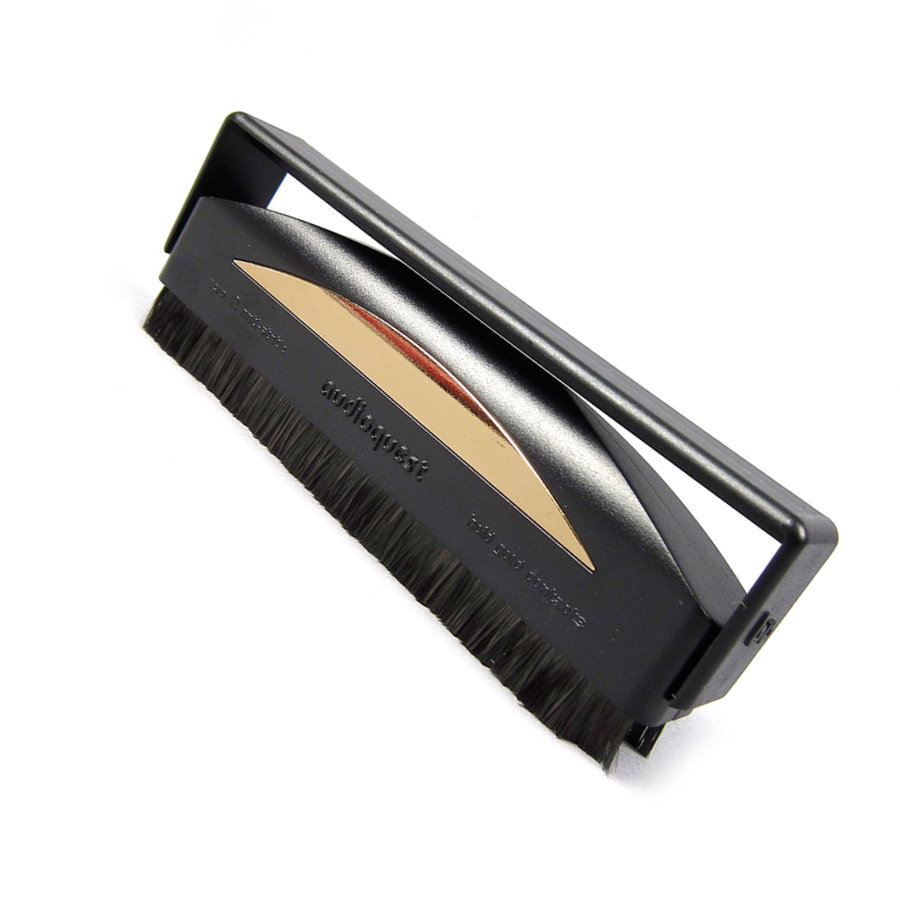 micro-scratches visible in the dead wax (lead out groove) area.
Audioquest developed a carbon fiber brush that has become our favorite. The bristles are firm enough to sweep the bottom of the grooves, but soft enough to prevent micro-scratches (which we've seen with our past favorite, the Hunt/EDA). The Audioquest brush is easy to use and has a built in foam cleaning pad in the handle that removes dust from the bristles when the brush is closed.
Use your dry brush before and after each and every play!
The next step beyond dry brushing the LP is wet cleaning. Here a specially designed record cleaning solution is applied and lightly worked into the grooves. The fluid lifts trapped or stubborn residue and debris from the bottom of the grooves while solvents dissolve contaminants. Wet cleaning is by far the most effective way to clean records, but there is are two critical caveats: fluid quality and complete removal.
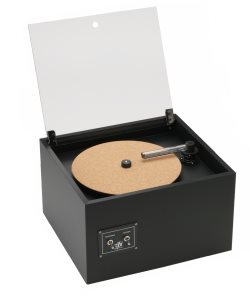 The real key to any wet cleaning system is the ability to completely remove the dirty liquid. It does little good to dredge debris from deep in the grooves only to have it deposit higher on the groove wall because it's not being completely removed. Enter the vacuum record cleaning system.
For some years now, the most effective method of deep-cleaning records has been the vacuum record cleaning machine (a popular choice is the VPI 16.5, pictured). This process is a combined approach utilizing a liquid cleaning solution together with a vacuum removal system. Here, one receives the benefit of the wet cleaning process, without the fear of residue left behind from incomplete removal. Machines range in price from a few hundred Dollars to several thousand. Plan on spending about $500 for a good quality machine.
Listeners are stunned by the sonic improvement of cleaning a record on one of these machines. Even brand new records sound better (due to removal of the mold release compound) and older records can be brought back to life by eliminating layers of crud deposited over time.
If you do not have a collection large enough to justify investing in a vacuum record cleaning machine you can still enjoy the benefits of wet cleaning by using the manual method. Though a more involved and time consuming process, it's well worth the effort. Again, complete removal of the used/dirty cleaning solution is absolutely critical, and this step is more difficult to accomplish without the aid of vacuum.
I've put together instructions (both in pdf and Power Point) for those interested in the manual cleaning process. You can access them here.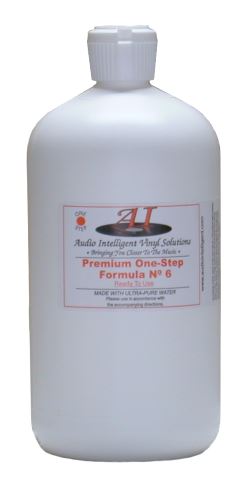
The type of cleaning fluid used is an important factor in determining the effectiveness of a vacuum record cleaning machine. Many commercially produced formulations are available, some are good, some not so good. Most solutions are water based with varying amounts of alcohol, and a pinch of surfactant. Products containing alcohol should be used with great care. Some theorize that an aggressive solution (those containing alcohol) can, with repeated use, can damage the LP by leaching the plasticizers that keep the vinyl pliable.
More common today are gentler solutions containing no alcohol. Our current favorites are the products from Audio Intelligent. A.I. offers both a simple one step approach as well as a more involved three step archival system. Their formulas are enzyme based for very gentle yet effective cleaning.
I caution against home brew concoctions. Store bought ingredients simply can't match the purity of commercial formulations. For example, the water used is the A.I fluids gets an ASTM 4 purity rating, the same as used in kidney dialysis! Further, every batch of solution is laboratory tested for content and quality. The cost of even the most expensive commercial fluids is still insignificant when you consider the value of your record collection.
 While no specific research has been done (to my knowledge) on just how often a record can be cleaned with a given fluid before damage occurs, I would suggest a conservative approach given the rarity of vinyl these days. With fluids containing alcohol, the general feeling is to clean your records only as often as is absolutely necessary. My sense is that with non alcohol based fluids you can clean the LP as often as you like.
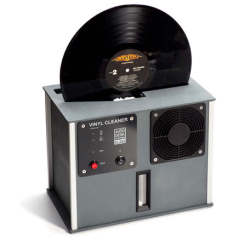
The latest evolution in record cleaning is the introduction of machines employing ultrasonic sound waves that reach into every nook and cranny of the LP grooves.The Audio Desk Systeme Vinyl Cleaner Pro (pictured at left) is the first LP cleaning machine to incorporate an ultrasonic cleaning cycle in addition to a more conventional mechanical cleaning (via bi-directional rotating microfiber cleaning drums), and the result is the cleanest LP's ever. The ultrasonic action of the Vinyl Cleaner Pro bursts millions of microscopic bubbles off the surface of the record, all the way to the bottom of the groove, where no fiber is fine enough to reach. And among vinyl cleaners the Audio Desk System Vinyl Cleaner is unique in using filtered air for drying thus eliminating the static charge that sometimes occurs with some machines.
Another cool feature, the Audio Desk Systeme Vinyl Cleaner Pro is fully automatic - just place the LP in the slot on top of the machine, push the button, and come back in 6 minutes for a thoroughly cleaned and dried LP (both sides!).
Conclusion: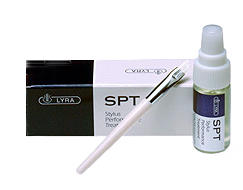
For the best long-term record care, I recommend wet vacuum cleaning or ultrasonic technology for deep cleaning, and a good dry brush for everyday maintenance. Use a vacuum or ultrasonic record cleaning machine when the record is new, and then several times throughout the life of the disc as required (a quality cleaning solution is critical). A good dry brush should be used prior to each and every play, and again after the record is played. Don't forget your stylus, which should be thoroughly cleaned before each play as well. Lyra SPT Stylus Cleaner is an excellent product.
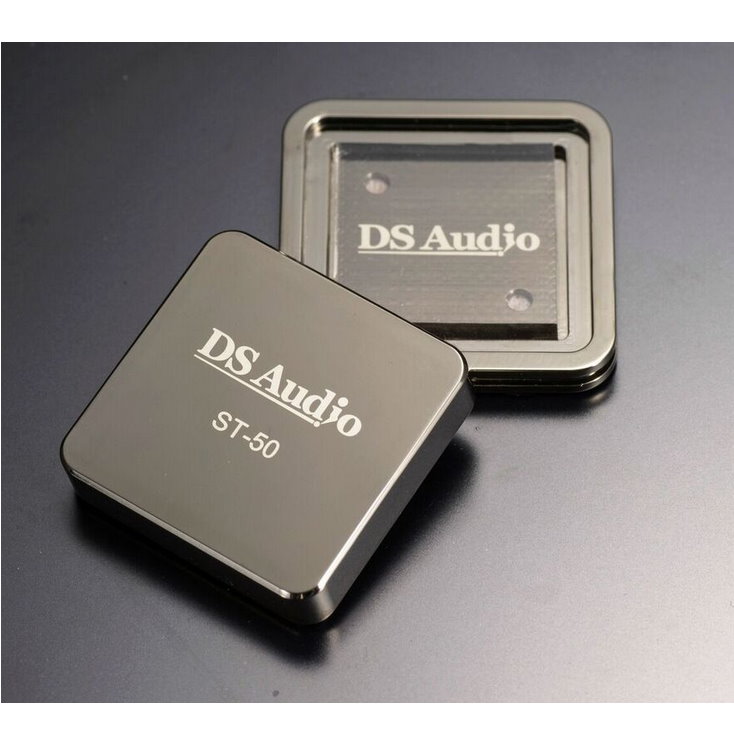 Another great option for stylus cleaning is the ST-50 from DS Audio. The DS Audio ST-50 stylus cleaner employs a specially designed urethane gel pad used in industrial clean room settings. Specifically, the material is employed in semiconductor production facilities to remove the tiniest dust particles at the micro level. Historically I’ve been reluctant to recommend any of the stylus cleaners using a gel pad (since none of the cartridge manufacturers I’ve spoken with would endorse them), but the DS Audio represents a shift in my thinking. Coming from a cartridge manufacturer who offers a $20,000 model, I’m confident that it is both safe and effective. Also, it's a one-time purchase as the gel is washable.
Once you have cleaned your collection, you must address proper storage techniques. LPs should always be be stored vertically to prevent warping.
I also strongly recommend that you treat your collection to both inner and outer sleeves. Internal sleeves should always be used to replaced the paper sleeves commonly found on LPs. I prefer rice paper, or poly-lined paper sleeves that use a rice-paper like liner material. Additionally, an outer sleeve will not only protect the record jacket, but reduce the influx of dust. A good selection of both inner and outer sleeves can be found at Sleeve City.