

- AUDIO ONE-TO-ONE Call Now: 210-805-9927
- Contact
- Register
- My Account
Imersiv D-1 HDR-A Multi-Path DAC

MY TAKE: The imersiv D-1 is represents a most significant advance in digital-to-analog conversion. The measurements are extraordinary. More importantly, what you hear confirms them. This is not incremental progress — it is a genuine paradigm shift, and I am thrilled to offer it.- Galen Carol
Some products come along that demand you sit up and pay attention — not because of clever marketing or flashy aesthetics, but because they represent a fundamental rethinking of how something works. The imersiv D-1 is that product for digital audio.
Imersiv is the consumer-facing brand of Millennia Media, a company with 35 years of pro audio heritage built on an almost fanatical commitment to accuracy and neutrality. Millennia’s preamplifiers are the leading choice for Hollywood film scores, classical music recordings, and major broadcast events including the Grammys and Oscars. Their LOCi phono preamplifier was designed under contract for the U.S. Library of Congress. With over 50,000 recording channels in use worldwide, if you listened to music or watched a film today, chances are good you heard a Millennia recording. This is not a boutique startup making bold claims — this is a company whose work has shaped the sonic fabric of modern culture, now turning its full attention to the DAC.
Paradigm Shift -
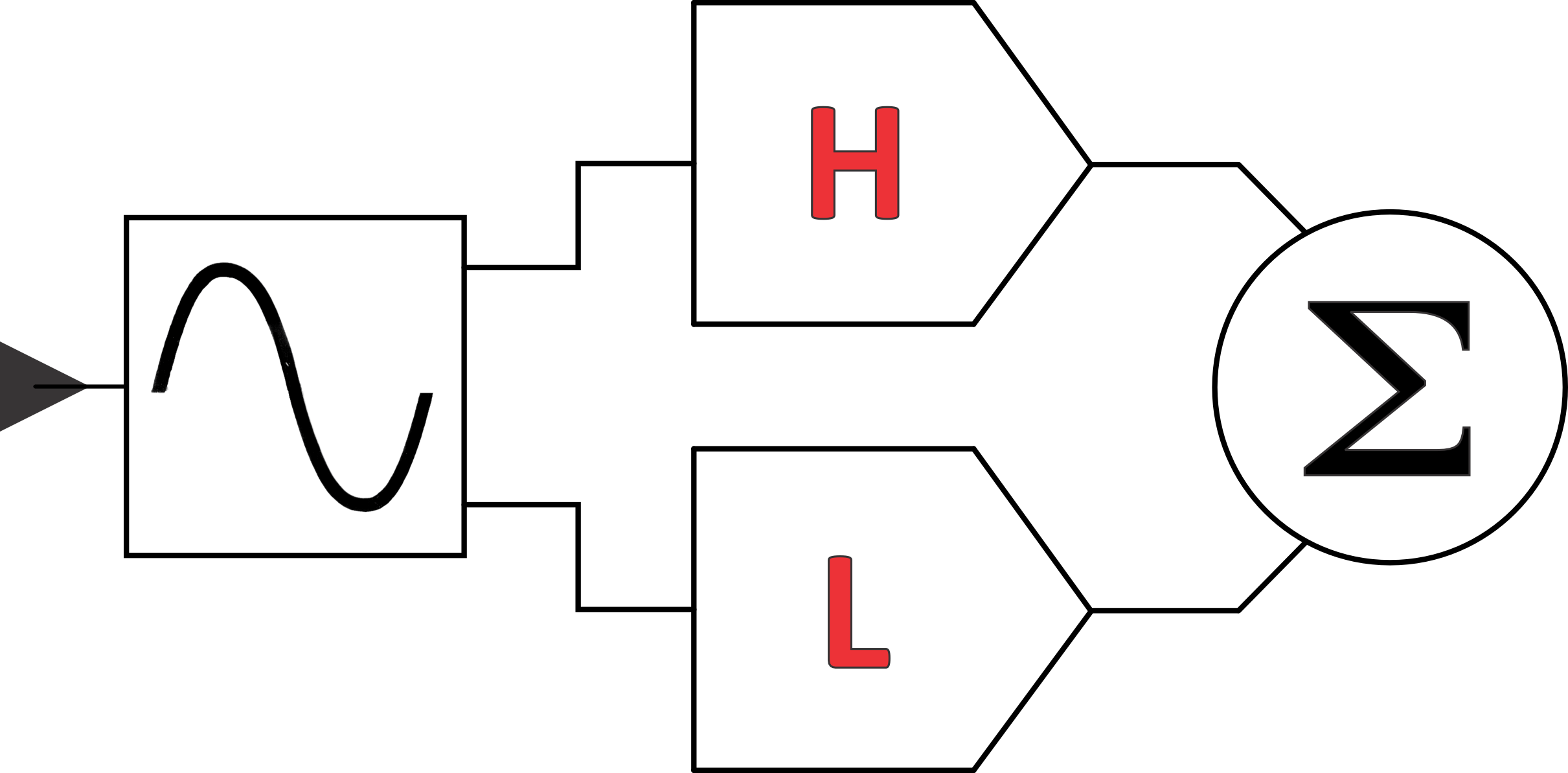
Welcome to the most significant audio breakthrough since digital conversion. Delivering noise, linearity, and dynamic range performance so advanced that modern test equipment cannot measure it. Imersiv HDR-A is a revolutionary new multiple-path audio architecture, poised to fully re-imagine the way we capture and deliver sound, from microphone to power amplifier, and everything in-between.
At the heart of the D-1 is what Millennia calls HDR-A — High Dynamic Range Audio — a triple-patented, multi-path architecture that took founder John La Grou over a decade to bring to fruition. The concept is elegantly analogous to HDR photography, in which multiple stacked exposures are intelligently combined into a single image. Here, multiple stacked audio levels are summed into a single audio file — one low-level path covering 0–90dB of dynamic range, and one high-level path covering 80–180dB — with a sophisticated DSP crossfade invisibly managing the transition between them.
The result is a DAC that operates at extraordinarily low distortion across its entire dynamic range, not just at the top. At low signal levels — where standard DACs exhibit their worst waveform distortion — the D-1’s multi-path HDR-A architecture routes signals through a fresh DAC core optimized specifically for that range. Single-path waveforms at these levels are jaggy and noisy; we hear this as poor image definition, atmospheric collapse, and a blurring of complex timbres. The D-1’s low-level signals remain pure and natural, even far below the threshold of human hearing.
The specifications are unlike anything else on the market. The D-1 achieves a broadband noise floor of just 40 nanovolts — approximately 40dB lower, or 100 times quieter, than today’s finest competing DAC designs. The D-1’s self-noise actually sits 25dB below what the leading test equipment, such as the APx555B, is even capable of measuring. True dynamic range comes in at 28 bits, or 168dB — a figure that renders today’s best single-path converters unable to compete, on paper or in practice.
Realization -
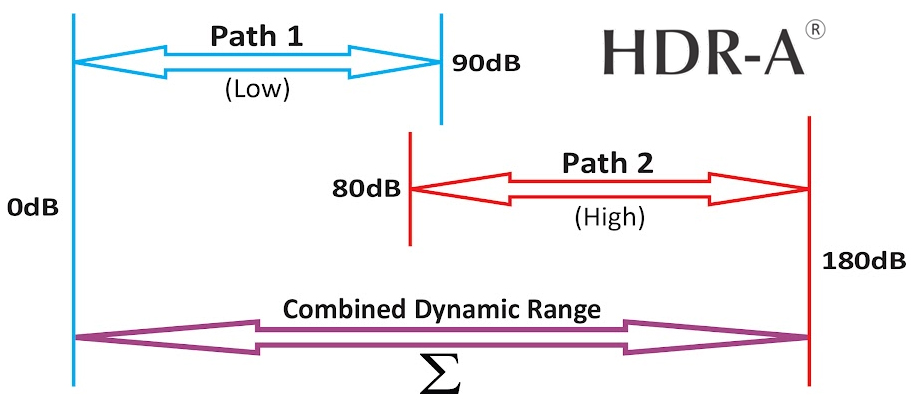
Perfecting HDR-A took over 10 years of continuous research and development. The graph shows how it works.
Path 1 is an audio signal with 90dB of dynamic range, from 0dB to 90dB. Path 2 is an audio signal with 100dB of dynamic range, from 80dB to 180dB. When paths 1 & 2 are combined, the resulting dynamic range is 180dB, from 0dB to 180dB. That’s multi-path high dynamic range audio.
M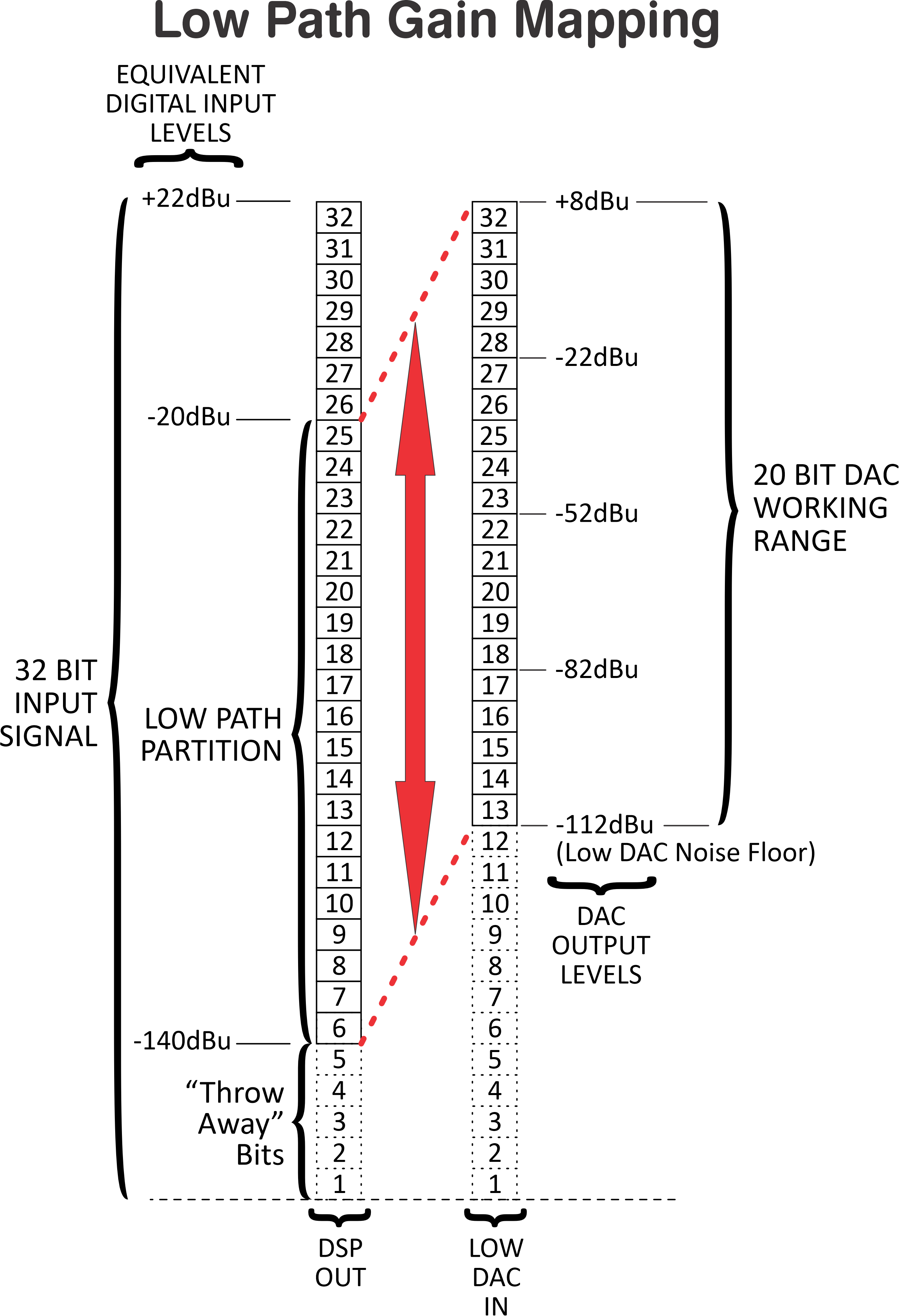 ulti-path HDR-A offers two major advantages over traditional single-path methods. First, it significantly reduces noise and distortion (THD+N). The imersiv D-1 achieves a remarkable 40 nanovolts of broadband noise, which is around 40 dB lower — 100 times quieter — than today’s best DAC designs. In fact, the D-1’s self-noise is 25dB below the measurement capability of today’s leading test equipment, such as the APx555B (see FAQ).
The second advantage is untethered headroom. HDR-A technology allows us to boost high-path headroom to any level without affecting our quiescent self-noise. The D-1 provides +22dBu (10 volts) of ISO-free* headroom while maintaining its profoundly low 40nV self-noise floor. This results in a true broadband, unweighted linearity and dynamic range of 28 bits or 168dB. (*inter-sample overs or inter-sample peaks)
Multi-path is the next design standard of audio architecture, from microphone to power amp, and everything in between.
page 2
Purity -
Acoustic recording engineers — whether in film scoring, classical music, jazz, or other genres — understand that spatial information is conveyed in the quiet moments: in the space between notes; in the subtle decay of a piano chord just before it fades from perception; in the brief instant a note is first struck, before it reaches its peak.
Quoting one of today’s top recording engineers, “On the music side, everything in the quiet neighborhood is where we get the ‘life’ and spatial cues in a recording. Distortion of lower-level partials is the very first casualty of any acoustic recording.”
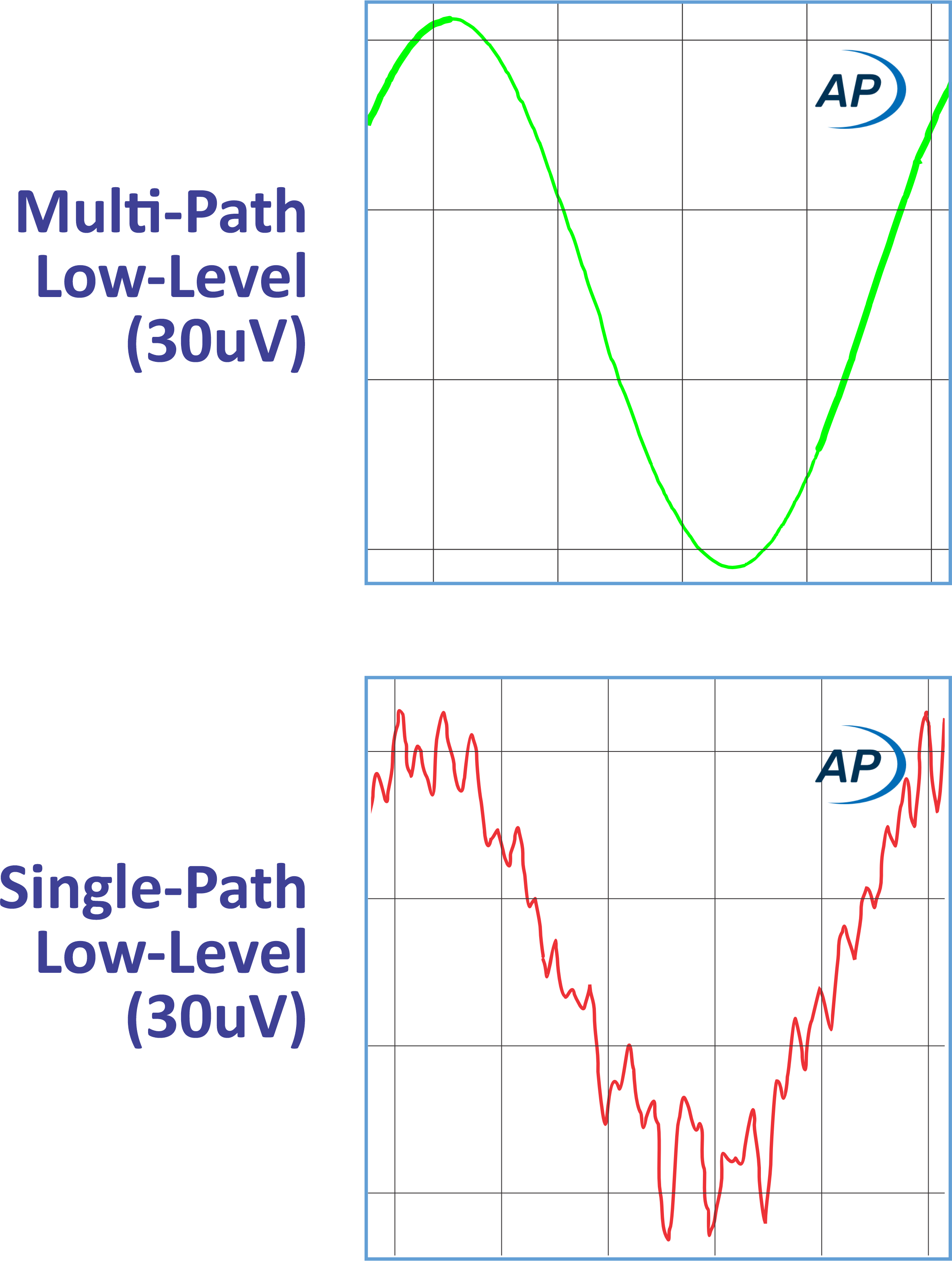
Extraordinarily pure low-level audio is a key reason why HDR-A topology delivers improved spatial and timbral realism compared with legacy single-path DACs. When audio levels drop below a certain threshold, HDR-A begins processing in a new DAC core — with dramatically lower distortion+noise (THD+N) performance.
See diagram. Compare a low-level, perceptible sine wave on the D-1 multi-path DAC versus a high quality single-path DAC. Single-path waveforms are jaggy and noisy. We hear this as poor image definition, atmospheric collapse, and a blurring of complex timbres — while HDR-A “new core” signals remain pure and natural, even far below the limits of human hearing.
Pro Proven -
Over forty Grammy-winning / plantinum recording engineers and film composers evaluated the imersiv D-1 DAC for one year. The results were unambiguous:
“a revelation”
“I went into shock”
“the clarity is incredible”
“this DAC is astonishing”
“unbelievably pure and clear”
“this will be the industry standard”
“like switching from 35mm to IMAX”
“the client thought he was hearing a 3D mix”
“works magic with metal and dense material”
“I can hear the space between the instruments”
“like hearing my music library for the first time”
Reviews -
Audio Xpress https://audioxpress.com/news/imersiv-d1-multi-path-digital-to-analog-converter-completes-32-bit-audio-chain Jan Didden Dec 2023
Audio Xpress https://audioxpress.com/article/aes-show-2024-ny-personal-highlights Roger Shively Oct 2024
Positive Feedback https://positive-feedback.com/show-reports/the-2024-aes-show/ Frank Doris Nov 2024
Positive Feedback https://positive-feedback.com/reviews/hardware-reviews/imersiv-d1-dac/ Bob Katz Dec 2024
Gearspace AES 2024 Show Report https://gearspace.com/board/showpost.php?p=17296758&postcount=76 David Rick Jan 2025
Tape Op Magazine https://tapeop.com/reviews/gear/166/d-1-multi-path-dac/ Larry Crane Apr 2025
Audio Xpress https://cc-webshop.com/collections/latest-editions/products/audioxpress-november-2025-pdf Stuart Yaniger & Oliver Masciarotte Nov 2025
Create the Future Design Contest (SAE Media) Create the Future Design Contest 2025 GRAND PRIZE in the CTF Design Contest, over 630 entries from the world's top inventors, 54 judges. Nov 2025
Recording Magazine https://www.recordingmag.com/imersiv-d-1-dac/ Paul Vnuk Jr. & Justin Perkins Dec 2025
Twittering Machines https://twitteringmachines.com/review-imersiv-d-1-dac/ - Michael Lavorgna Mar 2026 "If you want to hear the best sounding stand alone DAC I’ve heard, you need to listen to the Imersiv D-1. No ifs, ands, or buts."
Sound On Sound -https://www.soundonsound.com/reviews/imersiv-d-1: "The imersiv D‑1 is the first product to employ a revolutionary approach to D‑A converter design, and it shows. The D‑1 achieves a dynamic range that’s two orders of magnitude (40dB) greater than even the very best of its contemporaries, and a noise floor so low that it’s unmeasurable. This really is the new state of the art!
Pros
A genuine step‑change in DAC technology.
Groundbreaking technical specs.
Lower distortion clearly audible.
Easy to configure.
Cons
I can’t afford one!
page 3
In September 2026, the imersiv dealership in Hong Kong – Audio Exotics – wrote a
public statement on their Facebook page. Audio Exotics is the “highest end of the
audio high-end” in Hong Kong, with multiple $1M showrooms, and $100,000 -
$300,000 DACs on display. They had been selling the D-1 DAC for about 12 months
and, to this point, had written nothing publicly.
.....
This essay is written for those who have been following Audio Exotics for a long
while or are attempting to understand my journey. It is certainly not from the
uptick of endless debate over the competition between digital and analog. I am
not good at using superlatives to describe sound. Nowadays, you can cut the
review on product A and paste it as the text for product B review. They read
pretty much the same- warmer/brighter, wider/deeper etc. I am very tired of
this approach.
I shall also not touch upon the justification of price based on headline retail
price comparison with others. What concerns me the most is value, not price.
The former requires much deeper understanding to grasp, whereas price merely
indicates affordability.
Assuming our understanding of the concert of clarity is the same, I would like to
draw your attention to the D1 DAC by Imersiv in the US. John La Grou who
designed the revolutionary multi path HDR-A topology for DA Conversion won
the $25,000 Grand Prize in the 2025 “Create the Future Design Contest”
recognizing it as “a breakthrough technology that improves audio performance
by 100X compared to today’s very best audio equipment for applications
ranging from sound engineering to space missions to medical imaging.”
Achievements of technical specifications are never seen before in recent times.
The contest is well attended by scientists by numerous fields. It is a genuine
contest for scientific research breakthrough.
Indeed, the clarity of this DAC is astonishing by my standard with a price tag of
USD12,000, which is almost 1/30th the price of the most expensive dac
nowadays. It has been my reference at home since a year ago, driving the
Rivieralab AFM100 SE mono amplifier directly to control the Goebel AEON
Epoque reference speakers.
Ever since I've always wondered why I'd pay more for a DAC when the D1
outperforms all my previous, much pricier options, as much as 20x. The
understated aesthetic alongside a small physical size with a Shenzhen-made
transformer is a non-starter for some audiophiles. But that is not my concern. I
respect all who want to spend on whatever to justify anything. I am merely
telling you that I don’t buy the prevailing price system, where higher price
means better, especially in a cross-reference context in this industry.
If clarity is the only goal, I believe D1 pretty much champions all, easily
outperforming top dac made in the US and Switzerland, and everything I carried
before regardless of price. I did not write a single word about D1 for over a year
because I didn’t want to waste time fending off skepticism.
Extended listening of the D1 DAC always offers a pristine, architectural, and
razor-sharp neoclassical approach from Italian pianist Arturo Benedetti
Michelangeli, which always delivers a almost a detached objective perfection in
the performance of any music. For example, the Beethoven Piano Concerto
No.5, he builds a majestic, high-tensile framework where every note glitters with
diamond-sharp definition and immaculate rhythm. On the contrary, the same
performance under the command of Arrau Claudio favors a rich golden tone
and a broader monumental pacing that feels regal.
The D1, in my opinion, does a better job on transcribing detached objective
perfection with pristine clarity of Michelangeli than the rendition of Arrau
Claudio on Emperor. The APL-GR DAC Ultimate DAC which is my reference in AE
Sheung Wan, for instance, produces the golden tone slightly more golden than
D1. Some may find the APL sounds more coherent due to perception of longer
harmonic decaying tails. (User of APL dac in Hong Kong and Singapore, most of
them are using tube amplifier.)
Likewise, I always prefer the rendition of D1 on Heifeitz/Kogan than David
Oistrakh and Alfred Campoli on violin. I guess experienced listener understands
what I meant here. Now we are seemingly back to the realm of bright versus
warm, which is the last situation I would like to get into.
With the D1 in the chain, I always have the most transparent view ever into
everything displayed inside the recording venue. There are too many reviews on
the D1 dac by pro users across the world. They have much higher credibility
than me to comment on it. The bottom line is that it has been a reference for
me at home quietly for over a year, and it will continue to stay there.
Chris Leung, Audio Exotics, Hong Kong
Pedigree -
Built upon 35 years of innovation in pro-audio design and U.S.-based manufacturing, the imersiv D-1 embodies a heritage of excellence that has shaped the sound of our era’s most celebrated recordings. Millennia’s 2019 induction into the NAMM Technology Hall of Fame acknowledges our lasting influence and commitment to redefining professional audio. We adhere to aerospace-grade design, build, and QA standards, required by our esteemed clients — ranging from classical music recording engineers, broadcast engineers for major events like the Grammys and Oscars, and film scoring stages from Hollywood to Mumbai. It’s no surprise that pre-owned Millennia products consistently achieve top resale value within their professional categories.
Deeper Dive -
Join John La Grou and the imersiv design team for a short video tutorial (below). You will discover the inner workings of HDR-A D-to-A conversion and how it achieves 28-bits of dynamic range and linearity. You’ll also learn how multi-path architecture can be applied to every link in the audio signal chain, from microphones to power amplifiers, and everything in between.
Specifications -
Supported Input Format: 32kHz to 384kHz up to 32-bits. 1xDSD, 2xDSD, 4xDSD, Dante Digital
Inputs: 1x USB (B) 32-bit, 1x AES XLR, 3x SPDIF BNC, 1x Toslink,1x Dante (option), XLR Analog
Outputs: +22dBu diff-bal (9.75Vrms) max. Zero Inter-sample overs. 1.8 ohms Z
Level Control: 0.1dB or 1.0dB per step, selectable,154dB range (-130 to +24dB)
Manual Alignment: To 0.01dB left + right matching
Display Monochrome OLED: 256 x 64
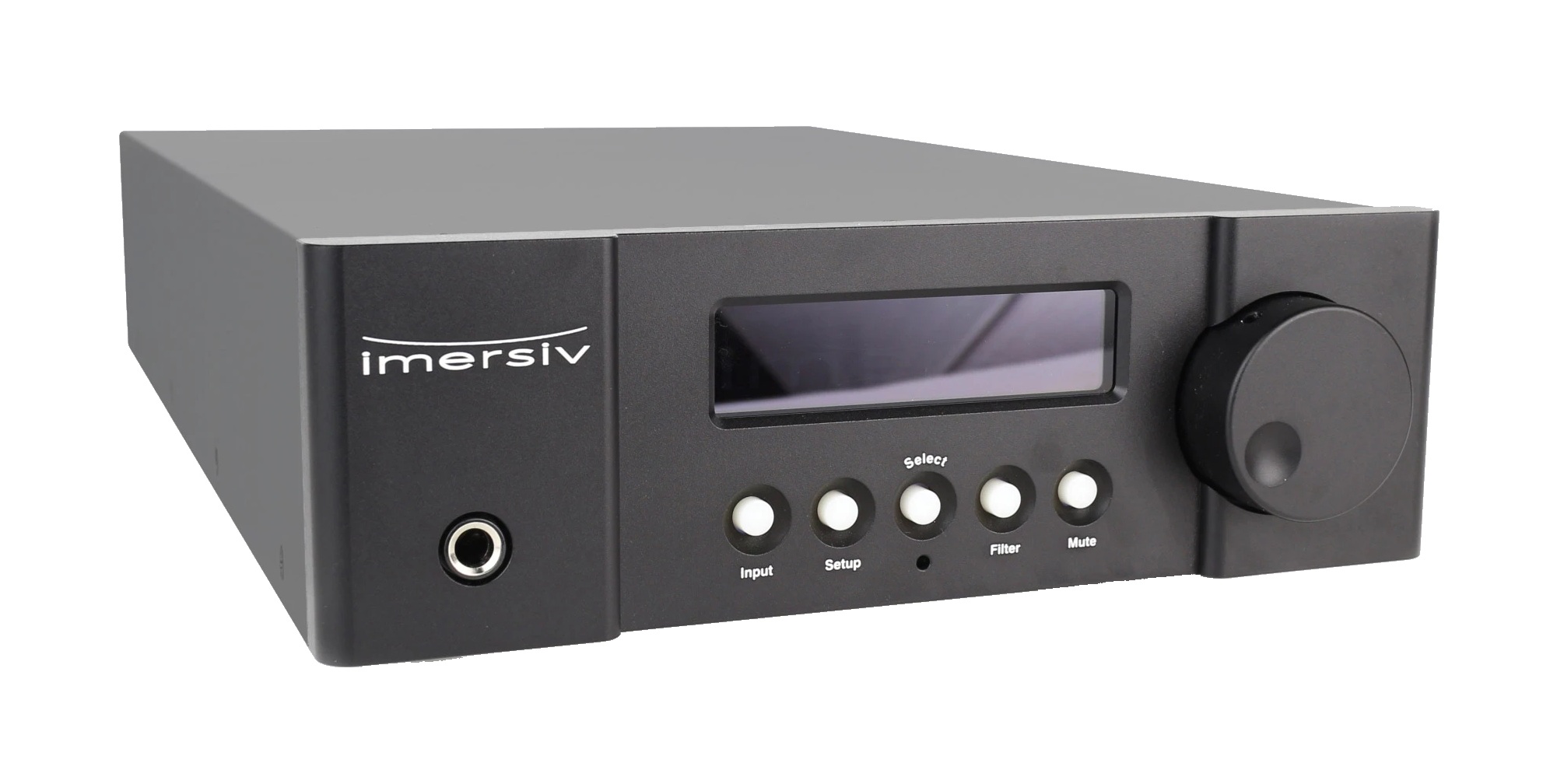
Front Panel Switches: Input, Setup, Select, Filter, Mute
Remote Control: IR, 27 functions, 4 reserved, 2 AA batteries required
Powering: 90-240V 50-60Hz
Power Use: 15 Watts nominal
Chassis: Dimensions 8.6”W x 16.3”D x 3.2”H (218W x 414D x 81H mm)
Weight: 7 pounds 7 oz (3.4kg)
Shipping Dimensions: 21” x 21” x 8”H (53 x 53 x 20 cm)
Shipping Weight: 13 pounds (5.5kg)
Included Accessories: Power Adapter,IEC Power Cable, Remote Control,2 AA Batteries, Quick Start Guide, BNC to RCA, Adapters (3)
Temperature Range:: 32°F to 104°F (0°C to 40°C)
Humidity Range: 35% to 85% RH, non-condensing
Frequency Response: 20Hz – 20kHz +/-0.1dB
THD+N at 1kHz: (22kHz BW) 0.0002% at +22dBu
THD+N at 20kHz (80kHz BW) 0.0005% at +22dBu
Self-Noise:20Hz-22kHz bandwidth -146dBu unweighted (calculated)
Dynamic Range: 168dB (28-bits)
Signal-to- Noise Ratio: 168dB (28-bits)
Linearity 168dB (28-bits)
Crosstalk: Better than -120dB at 1kHz
Headphone Output: 32ohm to 600ohm 2.8W max
DC Offset: 20uV max quiescent
Digital Filter: 6 selectable variations, see user guide
Polarity Flip: 180 degrees
Mute: Output Relay
Resampling: 192kHz
Calibration: See user guide
NOTES Performance specifications are broadband & unweighted.
Specifications subject to change without notice,
 Page 1
